Bibliographie
1) France : Sociologie des comportements sexuels - 2005
-
Pages : 128
-
ISBN : 9782707145819
-
Éditeur :
La Découverte
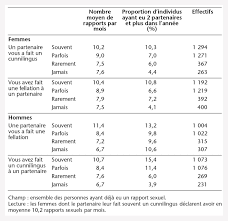
Tableau II - Fréquence des rapports au cours des quatre dernières semaines, par sexe et âge selon diverses caractéristiques ..
 Tableau IVb - Les pratiques sexuelles lors du dernier rapport
 Tableau 1. - Activité sexuelle selon la fréquence de la sexualité orale, chez les 25-49 ans
2) Polygynie
3) Autorisation de la polygamie
Polygamy
- Polygamy is legal in 58 out of nearly 200 sovereign states
- The
vast majority of them being Muslim majority countries situated in Africa
and Asia.
- In most of these states,
polygyny is allowed and legally sanctioned.
- Polyandry is illegal in virtually every state in the world.
- The rest of the sovereign states do not recognize
polygamous marriages.
Countries that recognize polygamous marriages
Africa
Asia
Oceania
Countries that only recognize polygamous marriages for Muslims
Note: These countries are included separately because they have specific legislation aimed only at Muslims.
Asia
Countries that don't recognize polygamous marriages
Africa
- Benin[58]
- Côte d'Ivoire: Polygamy may be punishable by six months to three years imprisonment, or a fine of CFA 50,000 to CFA 500,000 (US$80 to US$800).[59]
- Eritrea: Illegal since 1977, after 2015 polygamy is punishable with
"a definite term of imprisonment of not less than 6 months and not more
than 12 months, or a fine of 20,001 – 50,000 Nakfas."[60]
- Ethiopia[61][62]
- Seychelles
- Tunisia
Under customary law
Illegal de jure but still practiced
America
All countries in the American continent forbid polygamy.
North America
- Antigua and Barbuda
- Bahamas
- Barbados
- Belize
- Canada: All forms of polygamy, and some informal multiple sexual relationships, are illegal under section 293 of the Criminal Code.[89] Bigamy is banned by section 290.[90] However, for a long time, the law banning polygamy has not been efficient. As of January 2009, no person had been successfully prosecuted, i.e. convicted, in over sixty years.[91] In 2009, two acquittals on polygamy charges, arising out of the town of Bountiful, British Columbia, prompted the government of British Columbia to pose a reference question to the Supreme Court of British Columbia (i.e., the superior trial court). The reference questions asked if criminalisation of polygamy was consistent with the Canadian Charter of Rights and Freedoms; and, if so, under what circumstances could people be legally punished for polygamy.[92]
In November 2011 the court released its 335 page long decision, which
was that the criminal offence of polygamy is indeed constitutional, but
that it should not be used to prosecute minors for having taken part of a
polygamous marriage.[93]
Chief Justice Robert Bauman conceded that there is a conflict between
this law and some civil right principles, but stated that there are
other and "more important" issues which in this case take precedence. He
wrote (as quoted by CBC news[93]):
"I have concluded that this case is essentially about harm. More
specifically, Parliament's reasoned apprehension of harm arising out of
the practice of polygamy. This includes harm to women, to children, to
society and to the institution of monogamous marriage." Bauman argued
that there are cases where the "wives" (who may be rather young;
sometimes as young as 12 years) are abducted and abused, but because
they believe in a faith promoting polygamy, they are not willing to
bring complaints to the authorities. He reasons that these offences
sometimes may be stopped by applying anti-polygamy legislation. The
decision was welcomed by the Attorney General of British Columbia, and by a representative for the group Stop Polygamy in Canada. Likewise, according to the CBC news,[93] some polyamorous
groups in Canada expressed their relief, since Bauman had stated that
the law shouldn't apply to them unless they decide to formalize their
unions. Women's rights were central to decision.[93]
- Costa Rica
- Cuba
- Dominica
- Dominican Republic
- El Salvador
- Grenada
- Guatemala
- Haiti
- Honduras
- Jamaica
- Mexico
- Nicaragua
- Panama
- St. Kitts and Nevis
- St. Lucia
- St. Vincent and The Grenadines
- Trinidad and Tobago
Bigamy laws throughout the
United States
Misdemeanor
Felony
All forms of cohabitation outlawed (but a federal court has challenged this
[94])
South America
- Argentina
- Bolivia
- Brazil
- Chile
- Colombia
- Ecuador
- Guyana
- Paraguay
- Peru
- Suriname
- Uruguay
- Venezuela
Asia
- Armenia
- Azerbaijan
- China: Polygamy is illegal under Marriage Law passed in 1980. This replaced a similar 1950 prohibition.[97] In Hong Kong, polygamy ended with the passing of the Marriage Act of 1971.
- Georgia
- Israel
- Japan
- Kyrgyzstan
- Mongolia
- North Korea
- South Korea
- Taiwan: Polygamy is illegal by the 1930 ROC civil law.[98]
- Tajikistan
- Turkey: Polygamy was criminalized in 1926 with the adoption of the Turkish Civil Code, part of Atatürk's secularist reforms. Penalties for illegal polygamy are up to 5 years imprisonment.[99] Turkey has long been known for its promotion of secularism,[100][101][102] and has introduced measures establishing stricter bars against polygamy; these were passed by the ruling moderate Islamist AK Parti as well. In March 2009, AK Parti effectively banned polygamists from entering or living in the country.[103]
- Turkmenistan
- Uzbekistan
- Vietnam
Under customary law
Illegal de jure but still practiced
Europe
- Albania
- Andorra
- Austria
- Belarus
- Belgium
- Bosnia and Herzegovina
- Bulgaria: Illegal and punishable with up to three years imprisonment.[116]
- Croatia
- Cyprus
- Czech Republic
- Denmark
- Estonia
- Finland: The official prosecutor is obliged to take all cases to a
court where more two persons are married to each other and such
relationships cease to exist after the court has decided it.[117] Polygamic marriages performed abroad may be recognized only in narrow occasions, for instance in child custody matters.[118]
- France: Civil marriage registry illegal.
- Germany: Illegal, punishable with fine or prison time up to three years.[119]
- Greece
- Hungary
- Iceland
- Ireland
- Italy
- Kosovo
- Latvia
- Liechtenstein
- Lithuania
- Luxembourg
- Macedonia
- Malta
- Moldova
- Monaco
- Montenegro
- Netherlands: Marriage between more than two individuals prohibited; however, a samenlevingscontract may include more than two partners.
- Norway
- Poland
- Portugal
- Romania: Bigamy, defined as marriage conducted by a person which is
already married, is punishable by up to 2 years in prison or fine.
Knowingly marrying a married person is punishable by up to 1 year in
prison or by fine.[120]
- Russian Federation
- San Marino
- Serbia
- Slovakia
- Slovenia
- Spain
- Sweden: Sweden recognizes polygamous marriages performed abroad, and
all spouses are subsequently registered as spouses in the population
register, but other spouses than the first spouse may not always be
recognized in all occasions.[121][122][123] Only the first spouse is recognized as a spouse when decisions are made on residence permits and social security.[121] A Swede may have four spouses registered at most.[122]
- Switzerland: Polygamy is illegal by law. But polygamous marriage
conducted in another country may be accepted or rejected on a
case-by-case basis.[124]
- Ukraine
- United Kingdom:
Foreign polygamous marriages grant some welfare benefits only, but this
is being phased out with the introduction of Universal Credit.[125]
Polygamy is treated as bigamy if a second marriage (or civil
partnership) is contracted in the United Kingdom. No legal recognition
is extended to spouses of subsequent marriages after the first marriage
is recognised even when subsequent marriages are contracted abroad.
- Vatican City (Holy See)
Oceania
- Australia:
Polygamous marriages cannot be performed in Australia, but polygamous
relationships are still common within some indigenous Australian
communities.[126] Polygamous marriages entered into abroad are recognised for limited purposes[which?] only.[127]
- Fiji
- Kiribati
- Marshall Islands
- Micronesia
- Nauru
- New Zealand: Polygamous marriages cannot be performed in New
Zealand, but are permissible if they are legally performed in a country
that permits polygamy.
- Palau
- Papua New Guinea
- Samoa
- Tonga
- Tuvalu
- Vanuatu
Current legislation
In most countries, a person who marries a person while still being lawfully married to another commits
bigamy.
In all such cases, the second marriage is considered legally null and
void. Besides the second and subsequent marriages being void, the
bigamist is also liable to other penalties, which vary between
jurisdictions.
The United Kingdom, Australia, and New Zealand permit some benefits
for spouses of polygamous marriages performed in other countries. On a
case by case basis Sweden recognizes polygamous marriages performed
abroad but without giving residence or social security rights to other
spouses.
[121][122] In Switzerland polygamous marriages conducted in another country may be accepted or rejected on a case-by-case basis.
[128] see
§ Europe. In the Canadian province of
Saskatchewan,
which allows simultaneous, additional marital rights and obligations
for already married persons, prior to married persons becoming
divorced from their existing spouse.
[129]
The vast majority of Muslim majority sovereign states recognize
polygamous marriages: these states span from West Africa to Southeast
Asia. Exceptions to the legality of polygamy in the Middle East occur in
Israel, Turkey and
Tunisia.
[130] The
Palestinian territories — consisting of
West Bank and
Gaza Strip — permit
polygamous unions for
Muslim citizens of the territories.
[131]
Predominantly Christian nations usually do not allow polygamy, with a handful of exceptions such as the
Republic of the Congo, Uganda, and
Zambia.
Myanmar (formally known as
Burma) is also the only predominately Buddhist nation to allow for civil polygamous marriages.
[132]
Almost a dozen countries that do not permit polygamous civil
marriages recognize polygamous marriages under customary law. All the
northern states in Nigeria governed by Islamic
Sharia law recognize polygamous marriages. The
autonomous regions of Somaliland and
Puntland in northern Somalia also recognize polygamy, as does the country's
Transitional Federal Government itself, since the country is governed by
Sharia law. The recently independent country of
Southern Sudan also recognizes polygamy.
Polyandry is
de facto the norm in rural areas of
Tibet, although it is illegal under Chinese
family law. Polygamy continues in Bhutan
[34] in various forms as it has since ancient times. It is also found in parts of Nepal,
[107] even despite its formal illegality in the country.
[108]
Debates of legalizing polygamous marriages continue in Central Asian countries.
[citation needed]
International law
In 2000, the
United Nations Human Rights Committee reported that polygamy violates the
International Covenant on Civil and Political Rights
(ICCPR), citing concerns that the lack of "equality of treatment with
regard to the right to marry" meant that polygamy, restricted to
polygyny in practice, violates the dignity of women and should be
outlawed.
[133] Specifically, the reports to UN Committees have noted violations of the ICCPR due to these inequalities
[134] and reports to the General Assembly of the UN have recommended it be outlawed.
[135][136]
Many Muslim states are not signatories of the International Covenant on
Civil and Political Rights (ICCPR), including Saudi Arabia, United Arab
Emirates, Qatar, Malaysia, Brunei, Oman, and South Sudan; therefore the
UN treaty doesn't apply to these countries.
[137] It has been argued by the
Department of Justice of Canada that polygyny is a violation of International Human Rights Law.
[138]
Notable legislation
The
tables below cover recent pieces of legislation that have been either
debated, proposed or voted on; all of which concern a form of polygamous
union.
To permit polygamy
| Upper House |
Lower House |
 Iraq Iraq |
1963 |
Polygamous civil marriage (revoke of prohibitions)[139] |
Passed |
Passed |
Signed |
 Yes Yes |
 United Kingdom United Kingdom |
1987 or earlier |
Foreign marriages may receive benefits payments, being phased out[125] |
|
|
|
|
|
 Malawi Malawi |
1994 |
Customary law (recognizes polygamous unions)[140] |
Passed |
Passed |
Signed |
Yes |
 Libya Libya |
1998 |
Polygamous civil marriage [141] |
Passed |
Passed |
Signed |
Yes |
 South Africa South Africa |
1998 |
Customary marriage (civil recognition)[142] |
Passed |
Passed |
Signed |
Yes |
 Namibia Namibia |
2003 |
Customary law (recognizes polygamous unions)[143] |
Passed |
Passed |
Signed |
Yes |
| Namibia |
2004 |
Pension benefits to wives of a deceased president[144] |
- |
Failed |
- |
 No No |
 Uganda Uganda |
2005 |
Polygamous civil marriage (easing of laws; plus restrictions) |
Passed |
Passed |
Signed |
Yes |
 Kyrgyzstan Kyrgyzstan |
2007 |
Polygamous civil marriage[145] |
Failed |
- |
- |
- |
No |
 Kazakhstan Kazakhstan |
2007 |
Polygamous civil marriage[145] |
Failed |
- |
- |
- |
No |
 Uzbekistan Uzbekistan |
2007 |
Polygamous civil marriage |
Failed |
- |
- |
- |
No |
 Tajikistan Tajikistan |
2007 |
Polygamous civil marriage |
Failed |
- |
- |
- |
No |
 Turkmenistan Turkmenistan |
2007 |
Polygamous civil marriage |
Failed |
- |
- |
- |
No |
| Kazakhstan |
June 2008 |
Polygamous civil marriage[146] |
Failed |
- |
- |
- |
No |
 Iran Iran |
September 2008 |
Polygamous civil marriage (easing of laws)[147] |
Failed |
- |
- |
- |
No |
| Namibia |
July 2009 |
Polygamous civil marriage[148] |
Proposed |
- |
- |
- |
- |
 Russia Russia |
2009 |
Polygamous civil marriage |
Proposed |
- |
- |
- |
- |
 Kenya Kenya |
March 2014 |
Polygamous civil marriage |
Passed[15] |
- |
- |
- |
Yes |
To outlaw polygamy
| Upper House |
Lower House |
 United States United States |
July 1862 |
Morrill Anti-Bigamy Act, which made polygamy a misdemeanor offense in US territories and other areas where the federal government has exclusive jurisdiction. |
' |
' |
Signed |
Yes |
 United States United States |
March 1882 |
Edmunds Act, which reinforced Morrill by making polygamy a felony in the jurisdictions covered by Morrill; also prohibited "bigamous" or "unlawful cohabitation"
as a misdemeanor offense, which removed the need to prove that actual
marriages had occurred in order to obtain convictions on polygamy
related charges. |
Passed |
Passed |
Signed |
Yes |
 Turkestan ASSR (modern Kyrgyzstan) Turkestan ASSR (modern Kyrgyzstan) |
October 1921 |
Outlaws polygamy[149] |
Passed |
Passed |
Signed |
Yes |
 Thailand Thailand |
October 1935 |
Outlaws polygamy; polygamous marriage[150] |
Passed |
Passed |
Signed |
Yes |
 North Vietnam (modern Vietnam) North Vietnam (modern Vietnam) |
October 1950 |
Outlaws polygamy |
Passed |
Passed |
Signed |
Yes |
 Syria Syria |
1953 |
Restrictions on polygamous marriage[139] |
Passed |
Passed |
Signed |
Yes |
 India India |
1955 |
Outlaws polygamy and polygamous marriages for Hindus only[151] |
Passed |
Passed |
Signed |
Yes |
 Tunisia Tunisia |
1956 |
Ban on polygamy; polygamous marriages[152] |
Passed |
Passed |
Signed |
Yes |
 Iraq Iraq |
1959 |
Ban on polygamy; polygamous marriage[139] |
Passed |
Passed |
Signed |
Revoked |
 Côte d'Ivoire Côte d'Ivoire |
1964 |
New penal code outlaws polygamy; polygamous marriages (upholds existing) |
Passed |
Passed |
Signed |
Yes |
 British Hong Kong (modern Hong Kong) British Hong Kong (modern Hong Kong) |
1971 |
Outlaws polygamy[153] |
Passed |
Passed |
Signed |
Yes |
 Eritrean People's Liberation Front (modern Eritrea) Eritrean People's Liberation Front (modern Eritrea) |
1977 |
Outlaws polygamy; polygamous marriage (districts under Sharia exempt)[154] |
Passed |
Passed |
Signed |
Yes |
 Egypt Egypt |
1979 |
Restrictions on polygamous marriage; ease of divorce laws[152] |
Passed; abrogated |
- |
- |
- |
No |
 Egypt Egypt |
1985 |
Restrictions on polygamous marriage (less liberal)[152] |
Passed |
Passed |
Signed |
Yes |
 France France |
1993 |
Outlaws family reunion for polygamist immigrants[155] |
Passed |
Passed |
Signed |
Yes |
| Uganda |
December 2003 |
Outlaws polygamy[156] |
Failed |
- |
- |
No |
 Morocco Morocco |
2003 |
Restrictions on polygamous marriage[152] |
Passed |
Passed |
Signed |
Yes |
 Benin Benin |
August 2004 |
New penal code outlaws polygamy; polygamous marriages (upholds existing)[157] |
Passed |
Passed |
Signed |
Yes |
| Morocco |
February 2005 |
Restrictions on polygamous marriage (heavy restrictions)[158] |
Passed |
Passed |
Signed |
Yes |
| Uganda |
July 2005 |
Outlaws polygamy[159] |
Failed |
- |
- |
No |
 Indonesia Indonesia |
2007 |
Bans civil servants from living polygamously[160] |
Passed |
Passed |
Signed |
Yes |
| Morocco |
May 2008 |
Restrictions on polygamous marriage (heavy restrictions)[citation needed] |
Passed |
Passed |
Signed |
Yes |
| Uganda |
June 2008 |
Outlaws polygamy[156] |
Failed |
- |
- |
No |
 Iraqi Kurdistan Iraqi Kurdistan |
Nov. 2008 |
Outlaws polygamy except in selective circumstances[161] |
Passed |
Passed |
Signed |
Yes |
 Mayotte Mayotte |
March 2009 |
Mahoran status referendum, 2009 (passage outlaws polygamy)[162] |
Territory-wide Referendum |
Yes |
 Turkey Turkey |
May 2009 |
Disallows polygamists from immigrating into the country[163][not in citation given] |
|
|
|
Yes |
| Indonesia |
July 2009 |
Restrictions on polygamous marriage[164] |
Pending |
Pending |
- |
- |
| Namibia |
July 2009 |
Ban on polygamy & polygamous customary marriages |
Proposed |
- |
- |
- |
- |
See also


